
Care must change when the cat’s capacity changes.
Complex feline care connects grooming, boarding, sitting, medication, diabetic support, transport, mobility-aware handling, and veterinary communication. The goal is not to force a routine service model onto a cat who needs something different.
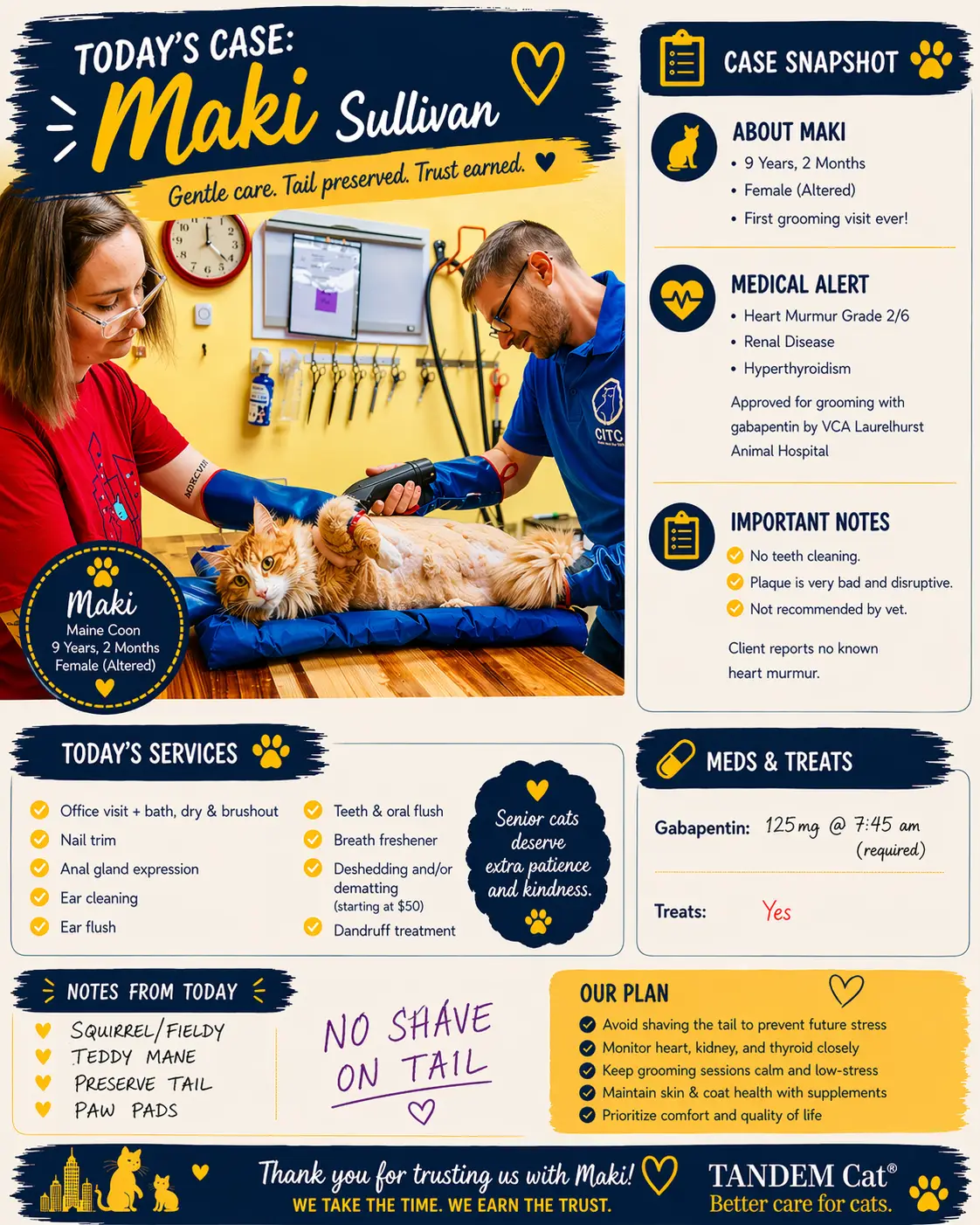
The care plan is built from the whole pattern, not a single label.
Medical history matters, but so do the cat’s current energy, movement, breathing, appetite, medication tolerance, sensory needs, prior care experiences, and ability to recover after handling.
Senior and frail cats
Shorter tasks, supported positions, slower transitions, lower stimulation, and prioritization of essential care over cosmetic completeness.
Cardiac and respiratory considerations
Reduced exertion, careful pacing, attention to breathing, and veterinary clearance when grooming, travel, or boarding may create risk.
Kidney disease and systemic illness
Hydration, appetite, medication, fatigue, temperature, and stress tolerance can affect whether and how a service should proceed.
Medication-dependent care
Service timing, dose windows, administration method, side effects, and the cat’s response to medication are incorporated into the plan.
Mobility, balance, and limb differences
Arthritis, weakness, amputation, blindness, deafness, neurologic changes, and altered balance require adaptive positioning and environmental support.
Sound, touch, and nervous-system sensitivity
Sound sensitivity, hyperesthesia, startle responses, and handling history can change the room, tools, pacing, and number of tasks attempted.
Complex care may move across several Cats in the City services.
The right starting point depends on the immediate problem, but the larger plan may combine multiple services and professional inputs.

Modified grooming
Task-prioritized, mobility-aware, medically informed grooming for cats who cannot tolerate a routine service.
Explore grooming →
Observed boarding
Medication, feeding, diabetic care, appetite response, elimination, behavior, and mobility are monitored together.
Explore boarding →
Care in place
In-home visits can preserve routine and reduce transport burden for medically stable but highly environment-dependent cats.
Explore cat sitting →
Supported movement
Transportation planned around medication, mobility, carrier tolerance, temperature, timing, and destination handoff.
Explore transport →Insulin decisions require real-time context.
Diabetic care is not simply “give the usual dose.” Food intake, stress response, glucose information, behavior, hydration, timing, and hypoglycemia risk must be considered together. The Cats in the City approach prioritizes safe withholding and prevention of hypoglycemia over rigid correction.
Complexity should be identified before the appointment whenever possible.
Records, medication lists, recent diagnoses, veterinary restrictions, mobility information, feeding history, prior service response, and emergency contacts help the team design safer care.
Share records
Provide current diagnoses, medications, restrictions, and recent changes.
Define the essential goal
Separate what must be done now from what can wait or be staged.
Choose the environment
Decide whether the cat is best served at home, in boarding, in grooming, or through veterinary care.
Plan escalation
Know when to pause, defer, call the guardian, or involve a veterinarian.
Describe the cat’s condition, current need, and recent changes.
The team can help determine whether grooming, boarding, sitting, transport, rehabilitation, or veterinary evaluation should come first.